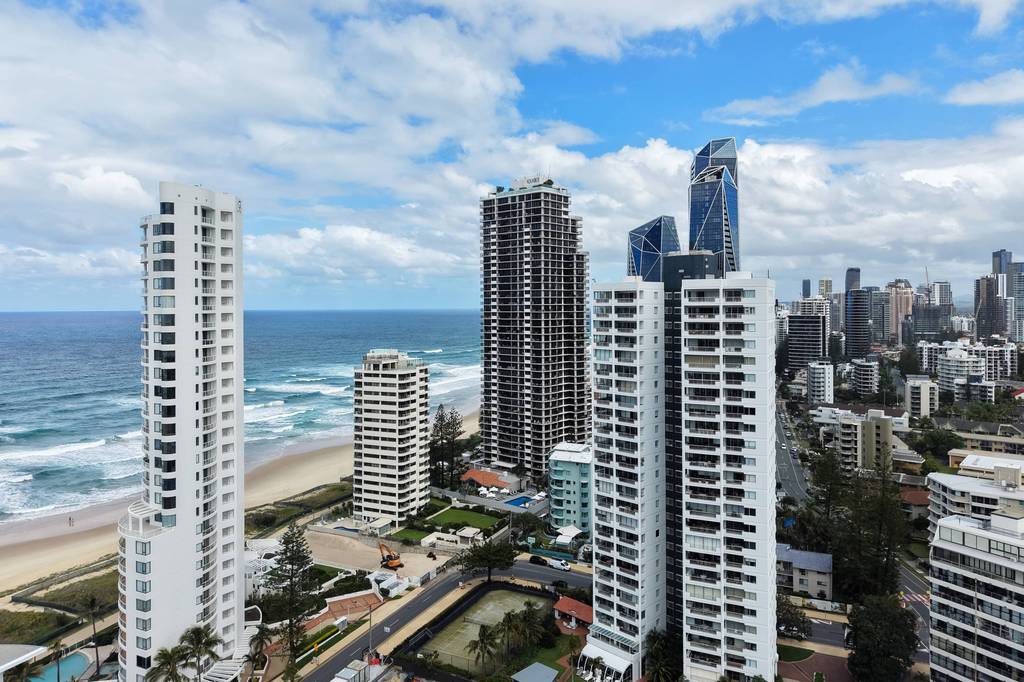
Whale season gives the 19th-floor apartment at Marriner Views another use for its dining table. Northcliffe Beach is directly across Fern Street, the Pacific opens beyond it, and binoculars turn a slow breakfast into a good reason to keep looking up.
The Gold Coast migration has a long local window, roughly late May to early November. The middle of winter is the time to choose if whales are the priority. In June or September, they are more likely to be one good part of a broader beach week.
The view is part of the stay
The 19th-floor three-bedroom has the confirmed ocean outlook for this sort of morning. Other apartments have different view combinations, so book the outlook that matters to you rather than assuming it. Either way, the beach is one minute across the road and the balcony is a comfortable place to wait between beach walks.
Height helps with the long scan of the water, but binoculars still do the work. Start with the line where the sea meets the sky, slow down, and look for the brief plume of a blow. Calm mornings are usually easier to read than windy ones.
That is the advantage of staying high rather than making a separate trip to a lookout. Make breakfast, keep an eye on the water, then head downstairs when the beach calls.
Take the tram north for a closer view
Florida Gardens G:link station is 750 metres from Marriner Views, a useful starting point for a car-free outing. Commercial whale-watching cruises leave from several Gold Coast waterfront locations, including Main Beach and Southport, so confirm the departure point before choosing the route.
Allow a half-day. The meeting point, timetable, duration, accessibility and weather policy belong to the current booking. The breeze offshore is a different thing from the breeze on Fern Street, so take a jumper, a windproof layer, sunscreen and sunglasses.
If the forecast has a large southerly in it, a land-based morning may be the better call. When you are aboard, the crew sets the pace around wildlife. Let them do that job.
Back to a wider apartment
The return works particularly well at Marriner. The heated saltwater pool, large spa, sauna and steam room are there for the cold hands and damp hair, then the rest of the day has room to spread out. Every apartment is 180 square metres, with two apartments to a floor and windows on more than one side.
For a couple, the two-bedroom superior has the same generous scale without a crowd. The 19th-floor three-bedroom is the one to consider if the ocean outlook is central to the trip.
The useful winter window
July and August offer the strongest chance to build a stay around the migration. June and September are worth considering if you would rather make whale watching one part of a quieter Gold Coast week. Check-in runs from 2 to 5 pm, with late arrival available by arrangement.
Check availability and reserve your apartment, or read about the 3-bedroom ocean view, the 19th-floor apartment built for season-long watching, and the 2-bedroom superior for a couple.